Join the meteo@uniparthenope sensor network
Contributing a station extends the spatial and temporal value of the network. A useful node is not merely a sensor: it is a maintained observational system whose siting, clock, connectivity and power supply are documented. This guide describes the reference Davis Vantage Pro/Pro2 edge stack and the information needed for onboarding [1–4].
Reference hardware
| Component | Required capability | Planning notes |
|---|---|---|
| Weather station | Davis Vantage Pro or Pro2 console and outdoor sensor suite | Select sensors appropriate to the scientific objective; document siting, height and obstructions. |
| Data interface | Davis WeatherLink USB/serial data logger or compatible console interface | The host normally exposes it as /dev/ttyUSB0; network interfaces may use TCP port 22222. Verify compatibility before purchase. |
| Minicomputer | Linux-capable computer with USB, persistent storage and Python 3 | A Raspberry Pi-class device is generally sufficient; choose an industrial device for harsh or unattended sites. |
| Network | Stable Internet path to the agreed MQTT broker | Ethernet is preferred; managed Wi-Fi or cellular can be used where signal and data plans are monitored. |
| Energy | Continuous, correctly rated power for console, interface, host and router | Use surge protection. For critical sites add a UPS; for solar sites size panel and battery from measured load, winter insolation and required autonomy. |
| Enclosure | Ventilated, serviceable protection appropriate to the site | Keep the minicomputer and USB interface dry and within rated temperature ranges. Do not compromise sensor exposure. |
No universal wattage or battery size is asserted here: measure the complete installation under load and apply a design margin. Networking equipment can dominate an off-grid power budget. Preserve local buffering so a short network outage does not become a data gap.
Software chain
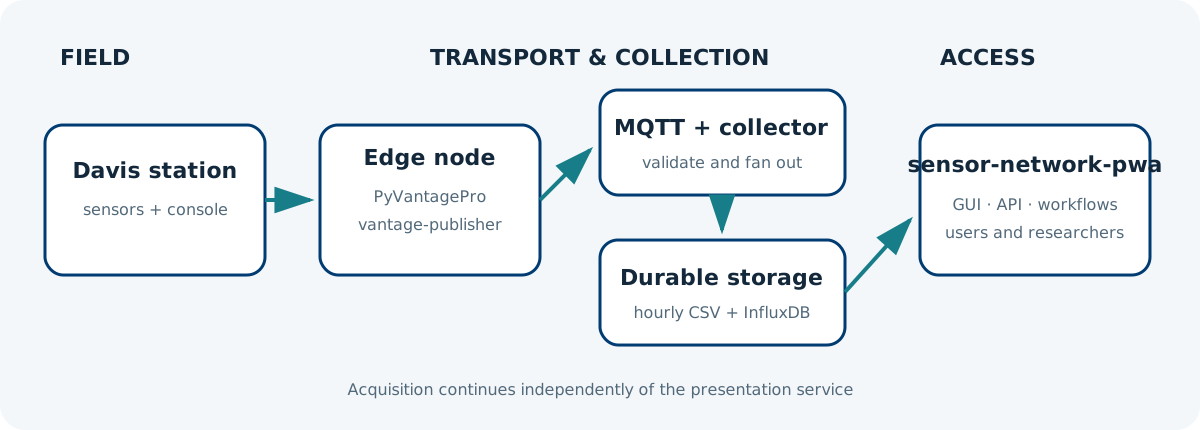
- PyVantagePro communicates with the Davis console, parses live LOOP and archive records, and exposes normalized values [1].
- vantage-publisher operates at the edge and publishes station observations to an agreed MQTT topic [2].
- sensor-network-collector subscribes centrally and writes the canonical hourly CSV hierarchy; optional sinks include InfluxDB v2 and Signal K [3].
sensor-network-pwareads those stored products and provides discovery, access control, analysis, downloads, APIs and alert workflows [4].
The edge node does not run this PWA, and the PWA never connects to the station or MQTT.
Commissioning sequence
- Survey and record the site. Record coordinates, elevation, sensor heights, exposure, nearby obstacles, ownership, maintenance contact and a site photograph.
- Install the station. Follow Davis installation and grounding guidance. Confirm console reception and plausible readings before connecting software.
- Harden the host. Install supported Linux, enable time synchronization, create a non-administrator service account, secure remote access, and configure updates.
- Verify the interface. Grant serial-device access and use PyVantagePro to read station time, metadata and current values. Do not run two clients on one serial port.
- Configure publication. Install
vantage-publisher, assign the station identity and MQTT topic supplied by the operator, and keep broker credentials out of Git. - Exercise outage behavior. Disconnect networking, restore it, confirm buffered delivery, reboot the node and verify automatic service start.
- Request central onboarding. Send the station identifier, site metadata, fields and units, cadence, contacts, visibility policy and commissioning evidence.
- Validate end to end. Confirm collector messages, hourly CSV creation, map coordinates, dashboard units and bounded API queries.
Acceptance checklist
- Timestamps are UTC/ISO-8601 and the host clock is synchronized.
- Coordinates and identity are stable and disclose no prohibited personal data.
- Values and units match the publisher/collector contract; sentinels are absent.
- Automatic restart, buffering, disk capacity and log rotation have been tested.
- Broker credentials are unique, least-privilege and operator-recoverable.
- A named person owns cleaning, calibration checks and incident response.
Scientific stewardship
Joining creates a continuing obligation to preserve provenance. Record hardware changes, relocations, firmware/software updates, calibration interventions and known periods of degraded quality. Such metadata is essential when observations support climatological comparison, model validation or teaching.
References
- CCMMMA, PyVantagePro, repository and examples.
- CCMMMA, vantage-publisher, edge publication software.
- CCMMMA, sensor-network-collector, collection and storage service.
- CCMMMA, sensor-network-pwa, data portal.
- Davis Instruments, product-specific Vantage Pro/Pro2 console, sensor and data-logger manuals supplied with the installed hardware.
docs/joining-the-network.md.